1/4
Uttānāsana — The Fold Your Body Has Been Doing All Along
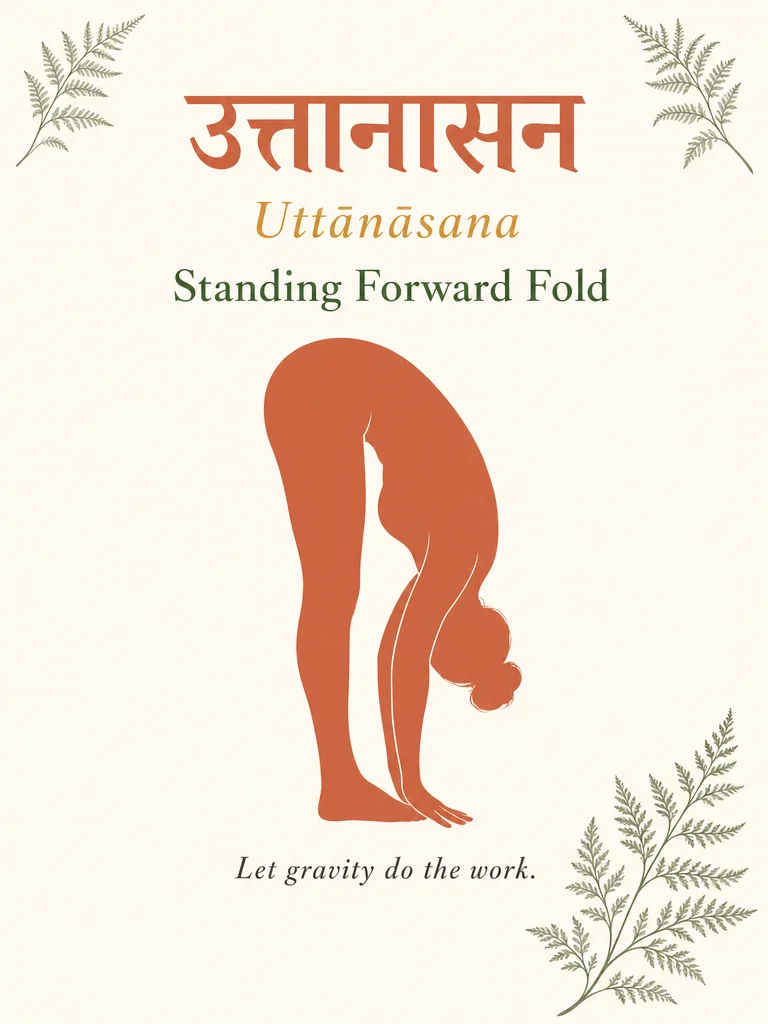
Uttānāsana (Standing Forward Fold) — the pose your body already knows from picking things off the floor. This 4-card set covers Sanskrit etymology (ut = intense, tān = stretch), physical and emotional benefits, age-group guidance for all four groups, the UT=upward / TAN=stretch mnemonic, and a no-mat floor-pickup practice grounded in Bhagavad Gītā 6.25 — śanaiḥ śanair uparamed buddhyā dhṛti-gṛhītayā.
June 11, 2026 · 7:06 AM
Gallery
उत्तानासन (Utt-TAH-nah-SAH-na) · Standing Forward Fold
The name
Ut (उत्) means intense or deliberate. Tān (तान्) means to stretch. Āsana (आसन) is the posture itself. So Uttānāsana is the intense deliberate stretch — and the paradox built into it is the entire point: you go down in order to stretch up through the entire back body.
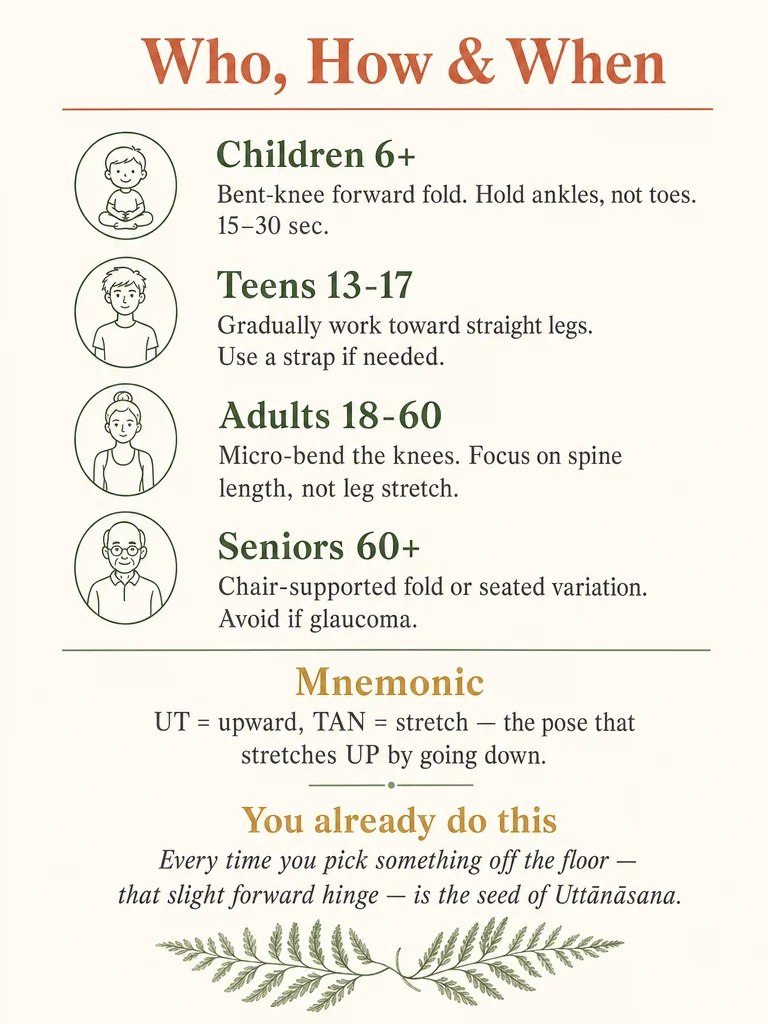
The mnemonic: UT = upward, TAN = stretch. The pose that stretches up by going down.---
What it actually is
You've been doing this pose your whole life. Every time you reach to pick something off the floor — the slight hinge at the hips, the spine rounding forward, the hamstrings pulling taut — that is the seed of Uttānāsana. The asana just asks you to do it slowly, with awareness, and to stay a little longer than you normally would.
The standing forward fold is one of yoga's great inversions-for-everyone. The head drops below the heart. Blood moves differently through the body. The whole back body — from heel cords to the base of the skull — gets to release in one long, continuous wave.
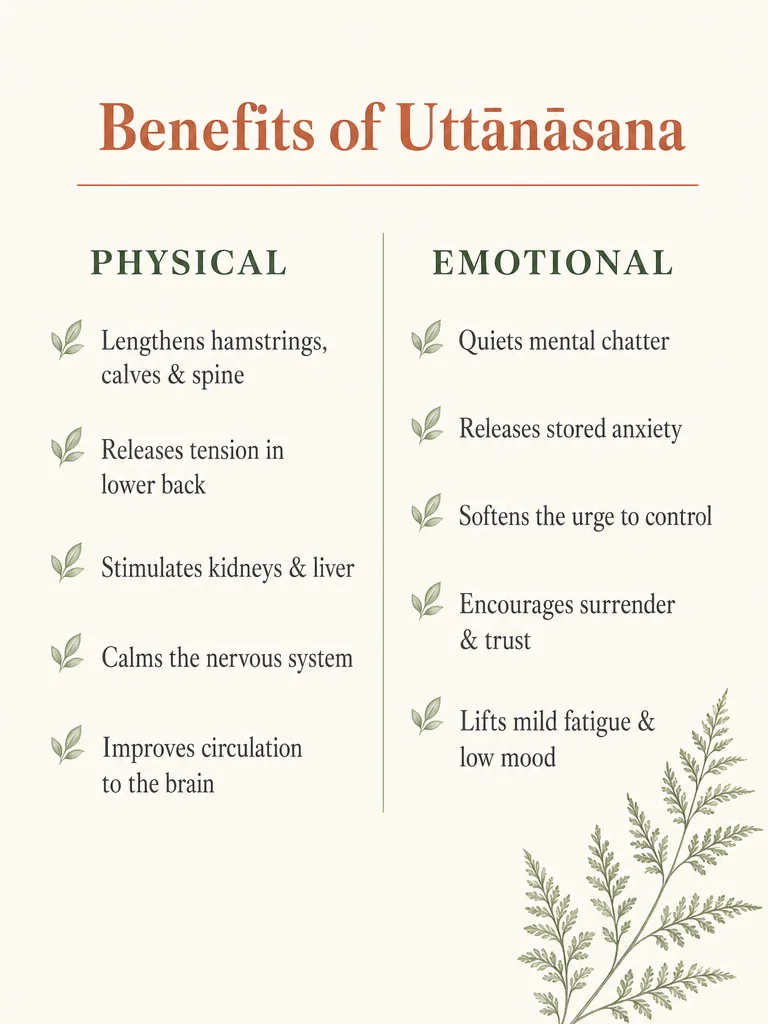
Physical benefits
- Hamstrings and calves: The entire back-leg chain lengthens. Most of us carry chronic tightness here from chairs, screens, and commutes.
- Lumbar spine decompression: Gravity gently separates the vertebrae. For people with lower-back tension, even a 30-second hang can feel like a reset.
- Kidney and liver stimulation: The compression and release of the abdomen massages the digestive organs.
- Brain circulation: With the head below the heart, fresh blood flows to the face and brain — a natural energy reset without caffeine.
- Nervous system calming: The forward fold activates the parasympathetic nervous system. Heart rate slows. The body reads it as safe.
Emotional and mental benefits
- Quiets mental chatter: The inversion and the physical effort of not fighting gravity tends to interrupt the mind's default loop.
- Releases stored anxiety: We hold tension in the back body — especially the hamstrings and lower back — in a way that's deeply connected to stress response. This pose reaches it.
- Softens the urge to control: Uttānāsana is, at its core, a surrender pose. You can't force your way deeper. You can only release.
- Lifts mild fatigue and low mood: A gentle inversion without the challenge of a full headstand. Useful on low-energy days.
- Encourages trust: Letting the head drop fully — no neck tension, just hanging — requires a small act of letting go. Over time, that carries off the mat.
Age-group guidance
Children 6+: Bent-knee forward fold. Encourage them to hold their ankles (not their toes — reaching for toes often causes back rounding rather than hip hinging). Hold for 15–30 seconds. Make it playful: "Can you touch the floor? Can you see between your legs?"
Teens 13–17: Gradually work toward straighter legs, but never at the cost of a flat back. A yoga strap looped around the feet is genuinely useful here — it gives something to pull against while keeping the spine long.
Adults 18–60: The most common mistake is locking the knees. A micro-bend in the knees allows the hip crease to deepen and the spine to hang rather than strain. Focus on length first, depth second.
Seniors 60+: A seated forward fold (Paschimottānāsana) or a chair-supported forward fold serves the same purpose with less demand on balance. Those with glaucoma or retinal pressure should avoid full head-drop inversions.
Anatomy (for curious practitioners)
Primary muscles: Hamstrings (biceps femoris, semitendinosus, semimembranosus), gastrocnemius and soleus (calves), erector spinae (releasing eccentrically).
Secondary / stabilising muscles: Gluteus maximus (maintains hip extension), core (prevents lumbar collapse), posterior tibialis (foot arch stability).
Joints involved: Hip joint (flexion), sacroiliac joint (decompression), lumbar and thoracic spine (flexion and elongation), knee joint (ideally neutral or with micro-bend).
Body systems activated: Parasympathetic nervous system (via the forward fold and inversion); lymphatic system (fluid movement from lower body); digestive system (mild abdominal compression).
Who should practice
- Beginners learning to sense their own back body
- Office workers with chronic lower-back and hamstring tightness
- Anyone looking for a quick mid-day nervous system reset
- Runners, cyclists, and those with tight calves and Achilles
- Practitioners working toward Paschimottānāsana, Adho Mukha Svanasana, or full inversions
Who should be careful / avoid
- Herniated lumbar discs: Round-back folding can increase disc pressure. Use a flat-back variation with hands on a chair seat instead.
- Glaucoma or high intraocular pressure: Avoid full head-drop. Use a supported or seated variation.
- Osteoporosis (advanced): Avoid spinal flexion under load. Consult a specialist.
- Recent hamstring tear: Gentle passive stretch only, or skip for now.
- Third trimester pregnancy: As the belly grows, full forward folding becomes uncomfortable and potentially compressive. Wide-legged variation or supported chair fold instead.
Safer alternatives for each caution: seated forward fold on a chair, supine hamstring stretch with a strap, or simply standing with a gentle hip hinge against a wall.
The Sanskrit quote
शनैः शनैर् उपरमेद् बुद्ध्या धृतिगृहीतया
Śanaiḥ śanair uparamed buddhyā dh&ṛti-gṛhītayā
Meaning: "Little by little, let the mind withdraw, through the intellect made firm by patience."
The Bhagavad Gītā here is not describing yoga technique — it is describing the inner act that is Uttānāsana: going slowly, releasing grip, letting the rational mind loosen its hold, and trusting the body's own wisdom.
Today's take-home practice
No mat. No studio. No special clothes.
Next time you pick something off the floor — a pen, a shoe, a book — pause at the bottom. Let your head hang completely. Take three slow breaths. Feel the pull from your heels through your calves, hamstrings, and all the way up the back of your skull.
That is Uttānāsana. You've been practicing it your whole life. Today, just do it with awareness.
Part of the Pragya Yoga daily series. Each post explores one asana through Sanskrit, body science, and a take-home practice for ordinary moments.
Comments